The slurries generated by the cutting of ornamental stone (Figure 1), namely granite, marble, and limestone, constitute an industrial waste produced in large quantities. This work therefore aims to assess the feasibility of reusing these slurries as a resource, within an environmental valorisation framework, through their application in the production of artificial soils.
Figure 1.
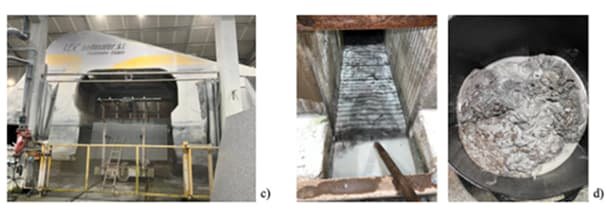
Equipment used in the sawing/cutting of ornamental stone at the TRANSGRANITOS – Mármores e Granitos do Alto Tâmega, LDA factory:
a) and b) Multifiol multi-wire cutting machine (uses diamond wires);
c) diamond blade cutting machine;
d) slurry conveyance system and appearance of a slurry sample collected near the cutting machine.
In an initial phase, the slurries were subjected to mineralogical and petrographic characterisation, using techniques such as thin-section microscopy and X-ray diffraction (Figure 2), with the aim of identifying the dominant and accessory mineral phases. This approach makes it possible to understand the composition and potential behaviour of the material, as well as to identify minerals that may constrain or enhance its future applications.
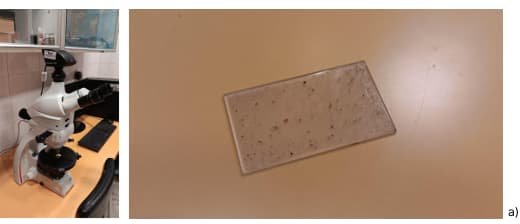
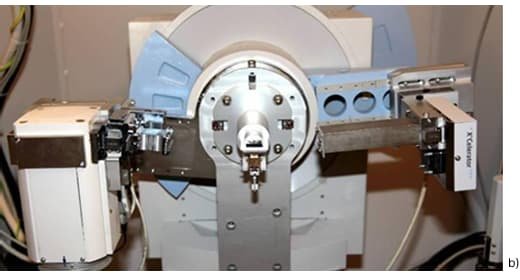
Figure 2.
a) Petrographic analysis of the thin section performed under transmitted light using the Leica DM750P petrographic microscope at the UTAD Geology Laboratory;
b) PANalytical X’Pert Pro MPD instrument (XRD).
Subsequently, the following organic residues were selected: mushroom substrate, grape pomace, plant residues from medicinal cannabis production, and almond shells (mesocarp), to be added to the slurries.
A preliminary reproduction test was carried out using the earthworm species Eisenia fetida, following the guidelines of OECD Test Guideline 222. Different formulations were considered, in which the mineral fraction of the artificial soil proposed by OECD 222 was replaced by slurries of different compositions.
The results obtained were considered valid for all treatments. Parameters such as variation in earthworm mass, mortality records, and the number of offspring were evaluated. Given the absence of negative effects resulting from the exposure of earthworms to the different slurries, a vermicomposting assay was subsequently developed using different mixtures of slurries and residues from mushroom production.
Formulations of slurries and residues from mushroom cultivation were prepared, and the mixtures were homogenised to obtain a representative substrate.
The mixtures were placed in perforated containers and subjected to vermicomposting with the introduction of earthworms (Eisenia fetida).
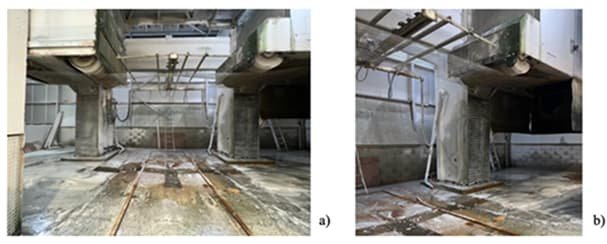
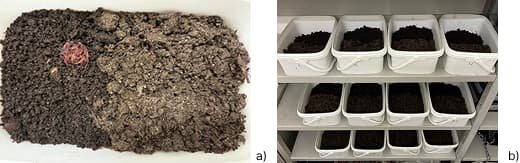
Figure 3.
a) Artificial soil produced in the laboratory in accordance with the guidelines of OECD Test Guideline 222;
b) Independent replicates of the different formulations.
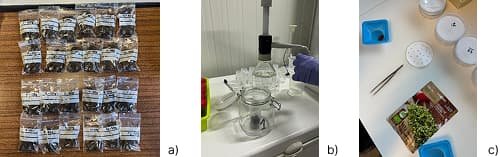
The substrate was maintained under weekly moisture control and monitored for biological activity. When a decline in biological activity was observed, the earthworms were removed from the vermicomposted material, and the quantities required for quality assessment tests were set aside. These included respirometric assays to quantify carbon dioxide emissions as an indicator of microbial activity and material stability, as well as germination tests to assess phytotoxicity (Figure 4). The formulations showing the best performance were subsequently replicated at an enlarged scale.
Figure 4.
a) Material reserved for the performance of quality assessment tests;
b) Respirometric assay;
c) Germination test.
This methodology will be replicated using the other organic residues mentioned above.
Subscribe our newsletter