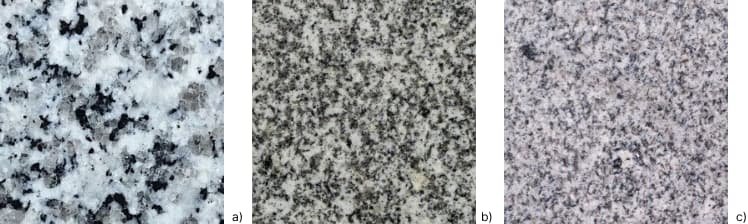
Figure 1.
a) Pedras Salgadas granite;
b) Cinza Penalva granite;
c) Branco Micaela granite.
The colour of granite surfaces can be modified and enhanced through the application of chemical products and controlled thermal treatment. Accordingly, this work aims to identify solutions that allow diversification of the visual appearance of granites, while preserving their technical characteristics and ensuring the quality required for commercial applications.
The tests are being carried out on granites representative of the materials marketed by Transgranitos, namely Pedras Salgadas, Cinza Penalva, and Branco Micaela (Figure 1). The samples were previously characterised from a colorimetric standpoint, allowing the establishment of reference values that will serve as a basis for evaluating the chromatic variations induced by the different treatments.
Figure 1.
a) Pedras Salgadas granite;
b) Cinza Penalva granite;
c) Branco Micaela granite.
Subsequently, different chemical compounds with potential to promote chromatic changes on granite surfaces after impregnation and exposure to thermal treatment were selected and tested.
Iron-based substances proved to be highly effective, namely iron(III) nitrate nonahydrate, iron(III) citrate, and ammonium iron(II) sulfate hexahydrate.
The addition of diluted hydrochloric acid enhances the impregnation of iron salts into the granite, as it promotes slight modification of the mineral surface and the removal of impurities, increasing the porosity and chemical reactivity of the surface layer of the material, thereby facilitating product fixation.
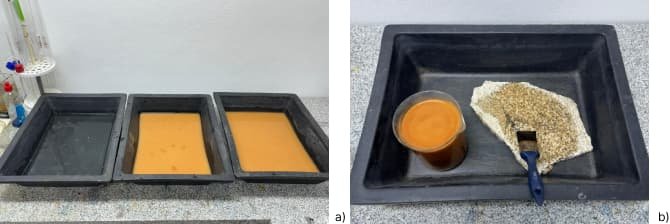
In parallel, different methods for applying the colouring substances were evaluated, including immersion, brush application (Figure 2), and spraying. Preliminary results showed that impregnation by immersion ensures greater uniformity and treatment effectiveness.
Figure 2.
a) Solutions for specimen immersion at room temperature;
b) Brush application method.
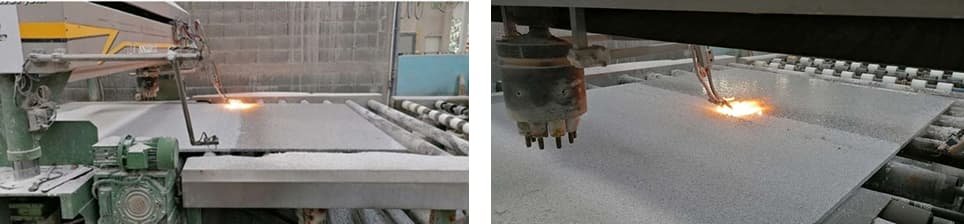
Once coloured, the specimens are subjected to the flaming process, which consists of exposing the granite surface to an intense flame (Figure 3).
Figure 3. Flaming process.
Different immersion times of the specimens in the colouring solutions will be tested, with multiple repetitions to ensure more reliable results.
Subscribe our newsletter